
dMAT 2027: A Complete Guide for Indian Master’s
By IITE | A detailed and practical guide to the Digital Master Test (dMAT)
Germany remains one of the most sought-after destinations for Indian students pursuing a Master’s degree, owing to its respected universities, strong research culture and low or nil tuition fees at public institutions. From the Winter Semester 2027 intake, however, a new requirement has been added to the application process for selected applicants: the Digital Master Test (dMAT). This guide explains what the test is, who must take it, the key dates, the exam structure, the registration procedure and how to plan your application around it.
1. What Is the dMAT?
The dMAT (Digital Master Test) is a computer-based, standardised academic aptitude test for Master’s applicants from India. It is conducted by g.a.s.t., the German non-profit organisation that also administers TestDaF and TestAS, and whose format was developed in cooperation with the Universities of Ulm and Kassel, with original development supported by the German Academic Exchange Service (DAAD).
It is important to note that the dMAT is not a mathematics examination. Some websites incorrectly describe it as the “Digital Mathematics Aptitude Test”. The correct name is Digital Master Test, and it assesses general academic aptitude rather than a single subject.
The responsibilities are divided as follows:
- g.a.s.t. conducts the test, handles registration, payment and test centres, and issues the dMAT certificate.
- APS India (Academic Evaluation Centre) continues to verify your academic documents and uses your dMAT result as an additional document in your APS file.
2. Why Has the dMAT Been Introduced?
India has a very large and varied higher-education system, with differing curricula and grading practices. A standardised test gives APS India and German universities a common, comparable measure of academic aptitude across applicants from different institutions. The dMAT does not replace APS document verification; it is one additional element within the process.
3. Who Needs to Take the dMAT?
The requirement applies to applicants who satisfy all of the following conditions:
| Criterion | Requirement |
|---|---|
| Application route | Applying through APS India |
| Level of study | Master’s programme |
| Bachelor’s degree field | Engineering & Technology: All B.Tech and B.Eng degrees, regardless of specialisation, as well as other undergraduate degrees in Engineering.Commerce & Economics: Commerce, Accounting, Finance and Economics.Business & Management: Business Administration and Management Studies.Tourism, Travel & Hospitality: Tourism, Travel, Hotel and Hospitality Management.Integrated & Dual-Degree Programmes: These are also included if any component or major field of study falls within the above disciplines. |
| Target intake | Winter Semester 2027/28 intake (recommended). While the requirement also covers the Summer Semester 2027 intake, the application timeline may be tighter, making Winter 2027/28 a more suitable option for students who need additional preparation time. |
Who is not affected?
- Applicants for Bachelor’s or PhD programmes
- Applicants for the Winter Semester 2026/27, as the requirement begins with the Summer Semester 2027 intake
- Bachelor’s students who have not yet completed at least 5 semesters of a 3-year programme or 7 semesters of a 4-year programme
- Applicants whose Bachelor’s degree falls outside the fields listed above
Exemptions. According to APS India, the following applicants are exempt:
- Applicants who completed their APS online registration, or shipped their complete APS documents, before 29 June 2026 (for that APS procedure)
- Applicants who have already received their APS certificate (for that completed procedure)
- Applicants in officially confirmed exchange, double-degree or university partnership programmes. They must submit a confirmation from the home institution, the German partner institution or the programme coordinator, including the group number, with their APS documents.
If your degree has a mixed or non-standard title, APS India applies a “major field” rule and advises taking the dMAT in boundary cases to avoid delays. If you are unsure, write to APS India at info@aps-india.de.
Check recognition first. The dMAT does not replace formal recognition of your degree. An APS certificate can only be issued for UGC-recognised degrees, and APS India strongly advises checking your institution’s status in anabin before registering.
4. Important Dates for dMAT 2027
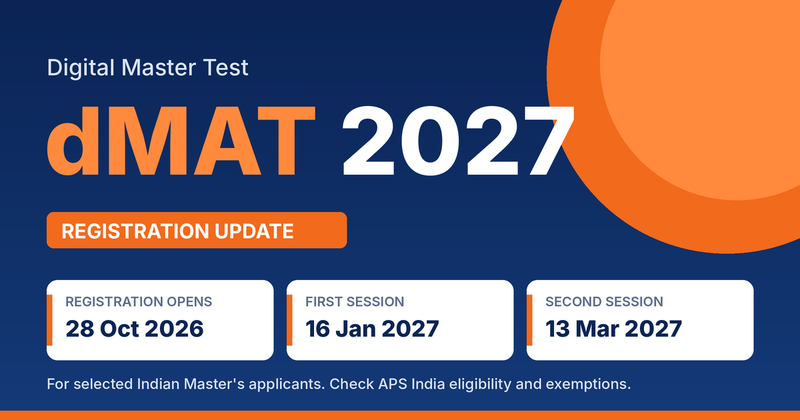
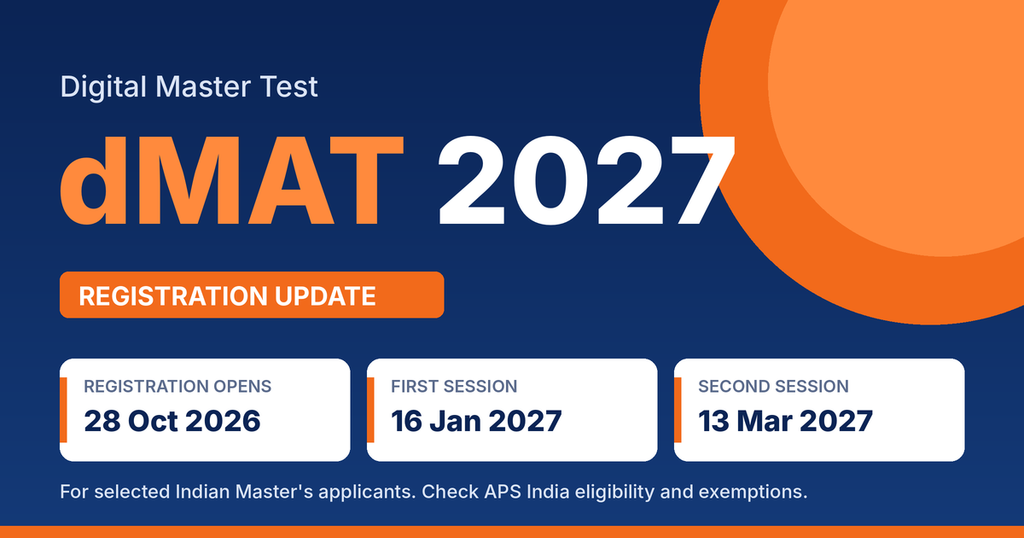
Registration for the 2027 sittings opens on 28 October 2026. The schedule for the two sessions is as follows:
| Session | Exam date | Registration deadline | Results |
|---|---|---|---|
| First session | 16 January 2027 | 4 January 2027 | 8 February 2027 |
| Second session | 13 March 2027 | 1 March 2027 | 5 April 2027 |
Seats are generally allotted on a first-come, first-served basis, so early registration is strongly recommended.These are exam dates. Most applicants using these two sessions are targeting the Winter Semester 2027/28 intake.
Please note that the very first dMAT sitting for India was held on 26 September 2026, with results on 12 October 2026; the dates above relate to the subsequent sessions.
5. Exam Format and Fee
| Parameter | Details |
|---|---|
| Mode | Computer-based, at g.a.s.t. test centres in Indian cities |
| Language | English |
| Duration | Approximately 3.5 hours, including a break |
| Question type | Single-choice questions |
| Structure | A core module (three subtests) and a subject module (General Academic Module) |
| Fee | €150, paid directly to g.a.s.t. at the time of registration |
| Validity of certificate | The certificate does not expire |
The core module measures general cognitive and analytical skills through three subtests: Figure Sequences, Mathematical Equations and Latin Squares. The subject module (General Academic Module) tests how well you apply those skills to academic problem solving, using a typical problem with related questions. The dMAT therefore rewards transfer and application skills rather than memorised facts. Applicants in the affected degree fields take the dMAT with the General Academic Module.
Test centres. The dMAT is currently offered at selected g.a.s.t. test centres. In India these are Ahmedabad, Bengaluru, Bhopal, Chandigarh, Chennai, Kolkata, Mananthavady, Mumbai, New Delhi and Pune. Centres are also available in Berlin (Germany) and Kathmandu (Nepal). The list may change, so please check the registration portal.
6. Step-by-Step Registration Procedure
- Visit the official g.a.s.t. website (d-mat.de) and open the dMAT India registration page.
- Create a participant account using a valid email address.
- Enter your personal details exactly as they appear on your passport. Keep your valid passport ready
- Select your preferred session (January or March 2027) and test centre.
- Pay the examination fee of €150 online by PayPal or by Mastercard/Visa credit card with 3D Secure authentication. Debit cards are not accepted.
- Save the confirmation and check the rules regarding refunds and rescheduling before the deadline.
Registration, payment, test-centre allocation and results are managed by g.a.s.t. and not by APS India. An issued APS certificate is not required in order to register for the dMAT.
Using your certificate. The official dMAT certificate is issued by g.a.s.t. and must be enclosed with your APS application documents. It can be downloaded from the g.a.s.t. test-taker portal once results are published, and your dMAT result will also be reflected on your APS certificate.
7. Planning the dMAT Alongside APS and University Applications
- Check university deadlines. Winter Semester application deadlines at many German universities generally fall between May and July, although they differ from one university to another. Start preparing early to ensure sufficient time for your dMAT exam, university applications and other admission requirements.
- Allow time for APS. APS India can issue your APS certificate only after the dMAT certificate has been submitted and checked, so a result received very close to a university deadline leaves little margin.
- Choose the session accordingly. The first session (16 January 2027, results 8 February 2027) suits applicants with later deadlines, while the second session (13 March 2027, results 5 April 2027) may be more appropriate for applicants considering a later intake.
- Submit other APS documents early. APS India allows you to submit your APS application documents before the dMAT certificate is available, so verification can begin early. Make sure every other required document is included in this first submission, because additional or updated academic documents cannot be added later together with the dMAT certificate.
- Keep a fallback. If a deadline is missed, the next available session or the Winter Semester intake may be the safer option.
8. How to Prepare for the dMAT
A structured preparation plan of several weeks is advisable, particularly because the examination lasts about three and a half hours on screen.
Official preparation material. g.a.s.t. publishes a preparation guide for the General Academic Module and short videos explaining the on-screen exam, including an introductory video, Figure Sequences, Mathematical Equations, Latin Squares and the Subject Module. No further detailed instructions are shown during the exam, so use all of these before test day.
- Understand the format. Study the official test description and sample questions published by g.a.s.t.
- Strengthen core aptitude. Practise logical reasoning, data interpretation, quantitative aptitude and analytical reading.
- Revise subject fundamentals. Review the core concepts of your Bachelor’s discipline for the subject module.
- Take timed practice tests. Build speed, accuracy and stamina through full-length mock tests on a computer.
- Review your errors. Maintain a record of mistakes and revisit weak areas weekly.
- Plan the final week. Focus on revision, rest and confirming your test-centre details and identification documents.
9. Frequently Asked Questions
Is the dMAT mandatory for every Indian student applying to Germany? No. It applies only to Master’s applicants applying through APS India whose Bachelor’s degree is in the specified fields and who are targeting the Winter Semester 2027 intake or later.
Do I need an APS certificate before registering for the dMAT? No. The two processes are connected, but an issued APS certificate is not a prerequisite for dMAT registration.
Does the dMAT replace APS verification? No. APS India continues to verify your academic documents. The dMAT is an additional document in your APS file.
Who do I contact for which query? Contact g.a.s.t. for registration, payment, test centres and results. Contact APS India for questions on documentation, exemptions and verification. Official contacts: kontakt@gast.de (g.a.s.t.) and info@aps-india.de (APS India).
What happens if I miss the registration deadline? You will need to register for the next available session, which may delay your application to a later intake. For this reason, deadlines should be noted well in advance.
Can I retake the test? Retake and rescheduling conditions are set by g.a.s.t. Please read the official rules carefully before registering.
Does the certificate expire? No. According to the published information, the dMAT certificate does not expire.
Is the dMAT a language test? No. It is an academic aptitude test conducted in English. It does not replace any English or German language proficiency requirement set by your chosen university.
Can I submit my APS documents before I receive the dMAT result? Yes. APS India allows this, so document verification can start early. The APS certificate itself is issued only after your dMAT certificate has been submitted and checked.
Is the dMAT a pass or fail test? No. A low score does not automatically lead to refusal of the APS certificate, and a good score does not guarantee admission. German universities decide independently how they use the result.
Can a good dMAT score make up for a degree from a non-recognised institution? No. The dMAT does not replace formal recognition, anabin status or UGC recognition of your degree.
10. Common Mistakes to Avoid
- Relying on unofficial websites for dates and fees instead of confirming on d-mat.de and the APS India website
- Registering at the last moment and being unable to secure a preferred centre
- Entering a name that differs from the passport
- Underestimating the time required for APS verification after the result
- Assuming the dMAT replaces APS verification or language requirements
11. Official Links and Further Reading
- dMAT for graduate students in India (official page)
- dMAT registration portal (g.a.s.t.)
- dMAT FAQ for graduate students in India
- APS India: dMAT information
More from IITE: German language classes in Bangalore at IITE
12. Conclusion
The dMAT is a significant new step for selected Indian Master’s applicants, but it is entirely manageable with early planning. Confirm your eligibility, select the session that fits your university deadlines, register in good time and prepare systematically.
How can IITE help? The IITE team provides guidance on eligibility, session selection, preparation and APS documentation. Although German is not required for the dMAT, it helps greatly with university life and career opportunities, and you can explore German language classes in Bangalore at IITE. Contact us to arrange a counselling session.
Disclaimer: This article is for general guidance only. The information is based on the official g.a.s.t. and APS India pages as updated in November 2026. Rules, fees and dates may change. Please confirm the latest information on the official g.a.s.t. (d-mat.de) and APS India websites before registering.

No Comment